-
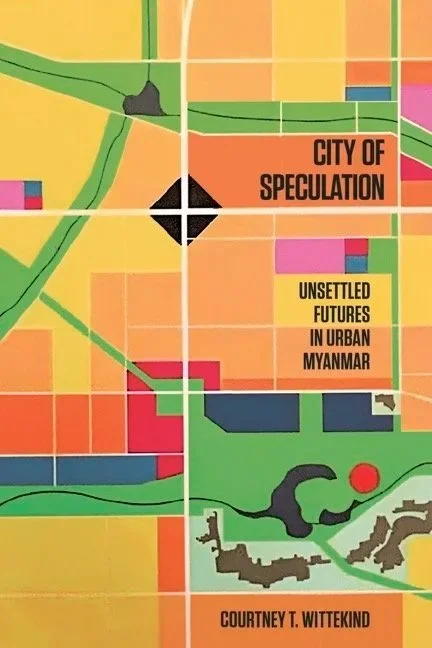
CITY OF SPECULATION: Unsettled Futures in Urban Myanmar
Courtney T. Wittekind -
In 2018, amidst a celebrated political transition, Myanmar's first democratically elected government since 1962 proposed a built-from-scratch "new city" just outside Yangon, the country's former colonial capital and current economic center. 20,000 acres of once-barren rice fields became the site of extraordinary developmental dreams. Farmers on Yangon's outskirts traded cultivation for speculation on land and property, betting on uncertain futures and weighing what, exactly, was worth risking for a chance at transformation. As plans for the new city stalled amid political turmoil, economic liberalization, a pandemic, and a military coup, speculation became both a source of hope and a means of survival when urban dreams faded.
-
Drawing on three years of site-based fieldwork and digital ethnography, Courtney T. Wittekind shows how speculation reshapes citizens' contemporary demands and forward-looking dreams—for themselves as well as their country—in times of crisis. Adopting the lens of "vernacular speculation," she reveals how ordinary people create value, interpret ambiguity, and act on possible futures, even as the promises of democracy and development collapse around them. A powerful account of how hope, anticipation, and uncertainty reconfigure everyday life, City of Speculation captures what it means to imagine—and gamble on—the future in the wake of profound upheaval.
-
Stanford University Press
November 2026
272 Pages
Hardcover ISBN: 9781503647664
Paperback ISBN: 9781503648531
REVIEWS
"With exceptionally lucid writing and adept storytelling grounded in rich ethnography, City of Speculation offers profound insights into how people in contemporary Myanmar manage precarious lives in uncertain times. Rather than treating speculation as a financial practice limited to elites and the economic realm, Courtney Wittekind delineates 'vernacular speculation' as a dominant cultural logic that pervades everyday life and produces new kinds of citizen-subjects."
— Karen Strassler, Queens College and The Graduate Center, CUNY
"The urban is less a matter of position than of things and imaginations moving through each other, unsettling and remaking what they mean, what value they have. To reside then means to speculate with nearly anything so as to viably move with this movement. Wittekind’s engagements with how peri-urban residents in Yangon constantly reassess their prospects through vernacular speculations—singular interweavings of time, affect, material, vision and interpretation—brilliantly conveys urbanity as something people do and think, making this book a groundbreaking shift in our understanding of urban life.”
— AbdouMaliq Simone, University of Sheffield
Articles
-
Scams all the way up: The scam as vernacular analytic of digital capitalism
Scams have proliferated under digital capitalism; so too have stories of scams and allegations of scamming. In this commentary, we focus on the latter to situate the scam as a “vernacular analytic:” an everyday mode of critique invoked to question the normative systems and institutions that rule our lives, but are experienced as exploitative or rigged. While this vernacular analytic is a powerful and pervasive means to highlight inequality, we argue that it obscures what is unique about scams amid capitalism's digitalization.
-
“Build the New City as Fast as Possible”: Speculation as Subsistence in Peri-Urban Myanmar
This article examines an ambitious plan to construct a built-from-scratch new city outside Yangon, Myanmar and sheds light on the contradictory responses sparked by rapid urban expansion. Despite fears that this megaproject would threaten the region's way of life, hopes for the new city's construction remained high. Residents went so far as to demand the city be built “as fast as possible”. In this article, I highlight the gap between residents’ pro-project enthusiasm and the expectations of civil society and development actors, who predicted locals would reject the planned new city.
-
“Take Our Land” : Fronts, Fraud, and Fake Farmers in a City-to-Come
Focusing on demonstrations held outside Yangon, Myanmar, in favor of urban development, this article intervenes in the binaries of “truth” versus “falsity” and the “genuine” versus “fake” to advance anthropological theorization on demonstration, speculation, and spectacle. The article traces contrasting claims about “real farmers” and their “genuine desires,” as marshaled by both supporters of a large-scale urban project and those who oppose it.
-
Livestreamed land: Scams and certainty in Myanmar’s digital land market
Scams are endemic to digital capitalism, whether they manifest as bitcoin bubbles or bullshit jobs. Drawing on two years of digital ethnography in Myanmar’s Facebook land markets, this article explains what happens when the land scam migrates online. By unraveling warnings of trickery, interviewing wary participants, and inhabiting Facebook Live real estate tours, we argue that the scam is a vocation born of hope and desperation that targets land as the most stable asset amidst crisis.
-
Networks of Speculation: Making Land Markets on Myanmar Facebook
Digital platforms have changed how property is sold and valued in the Global North, yet little is known about digital tools in emerging land markets. Drawing on in situ and digital ethnography, we argue that Facebook plays a key role in making a new kind of market in Myanmar, where land is transformed into a speculative asset, exchanged across ever-expanding networks.
-

Rethinking Land and Property in a “Transitioning” Myanmar: Representations of Isolation, Neglect, and Natural Decline
In this article, we assess ideas of “progress” in the evolution of Burma/Myanmar studies, asking whether shifting conditions might offer openings to reconsider narratives about the country. We question two recurring tropes consistent across the work of journalists, policy analysts and scholars: an alleged history of undifferentiated “isolation,” and the ensuing state of Burma/Myanmar following a seemingly “natural” decline.
-
Road Plans and Planned Roads: Entangled Geographies, Spatiotemporal Frames, and Territorial Claims-making
In this article, I investigate conflicting claims to land made in the peri-urban areas of Taunggyi, in Myanmar’s Shan state. By exploring case studies linked to proposed road construction in Pa-O majority regions, I develop an approach to “land grabs”- and the counter claims-making they impel- that foregrounds the spatiotemporal, showing how distinct senses of time are activated, embodied, and re-animated through encounters with particular spaces.
-
A Space “In-Between:” Liminality and Landscape on the Thailand-Burma (Myanmar) Border
Drawing on ethnographic research along the Thailand-Burma border, this article analyzes the experiences of migrating youth, asking how their socially ambiguous positioning relates to the “liminal landscapes” in which they move. Drawing on images captured on “photo-walks” throughout the border region, I argue that young migrants strategically exploit potentialities intrinsic in the ambiguous landscape of the border region.